
Have you ever added something to your cart, hovered over the checkout button, and then thought, “Maybe I’ll come back later”? Most online shoppers have. That moment of hesitation is where many WooCommerce store owners lose potential customers. Not because the product is bad. Not because the price is unreasonable. Often, it’s because the customer is buying from that store for the very first time.
There’s a trust gap. For years, first-purchase discounts have been one of the most popular ways to bridge it. The problem? Most stores approach discounts like a blunt instrument. They throw 20% off banners across every page, hope conversion rates rise, and wonder why profits feel thinner a few months later.
I’ve seen this happen more times than I can count. A merchant notices sale slowing down. They launch a bigger promotion—sales spike. Everyone celebrates. Then the promotion ends, and things slide right back to where they started.
Sometimes worse. The best first-purchase discount strategy isn’t necessarily the most generous one. It’s the one that convinces a customer to take that first step without teaching them to expect discounts forever. That’s a very different goal.
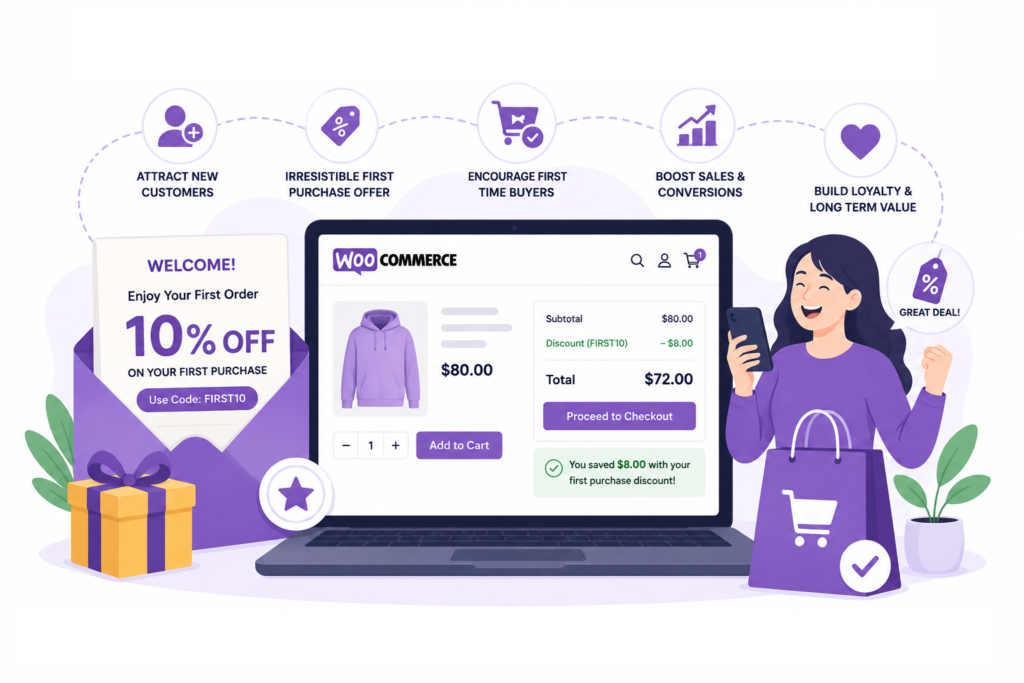
First Purchase Isn’t Really About Price
Many store owners assume new visitors are obsessed with saving money. They’re usually not. They’re evaluating risk.
Think about the last time you bought from a brand you’d never heard of before. Chances are you weren’t sitting there calculating whether a 12% discount was better than a 15% discount. You were wondering things like:
- Will this actually look like the photos?
- Is shipping reliable?
- What happens if I need a refund?
- Can I trust this business?
The discount helps tip the scales. It’s less about saving money and more about creating enough confidence to decide. That’s why some stores see impressive results from a modest offer while others struggle despite offering much larger discounts. The percentage itself often isn’t the deciding factor. Context is.
Why Bigger Discounts Can Backfire
There’s a strange thing that happens when discounts become too aggressive. Customers start asking questions. A luxury skincare brand offering 10% off a first order feels fairly normal.
The same brand offering 40% off immediately raises eyebrows. Why so much? Are margins inflated? Is demand weak? Will everything be discounted next week anyway?
Consumers don’t always consciously think through those questions, but the impression lingers. I’ve watched premium brands damage their positioning simply because they believed larger discounts automatically meant higher conversions.
Sometimes the opposite happens. A smaller incentive can feel more credible. More intentional. Credibility matters, especially for first-time buyers. People don’t just want a deal. They want reassurance.
Sweet Spot Most WooCommerce Stores Miss
After looking at countless promotions across different niches, fashion, home goods, supplements, pet products, and specialty foods, a pattern tends to emerge. The strongest performers usually aren’t offering dramatic discounts. They’re offering reasonable ones.
Somewhere around 10% to 15% often strikes a healthy balance. Enough to create urgency. Not enough to undermine the product’s perceived value. More importantly, these offers don’t leave merchants staring at shrinking margins every month. That’s a part people rarely talk about.
Discounts aren’t free. Every percentage point comes directly from revenue you’ve already worked hard to earn. Which is why sustainability matters. A strategy should still make sense six months from now, not just during the first week of testing.
Timing Matters More Than Most Merchants Realize
Here’s something I’ve noticed repeatedly. Many stores show their first-purchase offer within seconds of a visitor arriving. Popup. Discount. Email form. Instantly. It’s understandable. Merchants don’t want visitors leaving without seeing the offer.
But imagine walking into a physical store and being greeted by a salesperson yelling discount codes before you’ve even looked at the shelves.
Feels odd, doesn’t it? Online shoppers aren’t much different. Visitors need a moment to explore. To browse. To build interest. The most effective discount campaigns often appear after some sign of engagement:
A few product page views. A certain amount of time on site. An exit attempt. An abandoned cart signal. By then, the customer understands what they’re buying. The discount becomes a helpful nudge rather than a desperate sales tactic.
Email First, Discount Second
This is where many WooCommerce stores leave money on the table. They focus entirely on the coupon. Not the customer relationship.
Let’s imagine two nearly identical stores. The first displays a public coupon code on every page. The second asks visitors to join its email list before receiving the discount. Both stores generate first orders.
But only one is building a long-term marketing asset. That email address has value far beyond the initial sale. Some subscribers won’t buy immediately. That’s normal.
A few days later, they might open a product guide. A week later, they could click on a customer review. Two weeks later, they might finally place an order. Without the email connection, that opportunity disappears. A discount gets attention. An email list creates future revenue. The distinction matters.
Not Every Store Needs a Percentage Discount
One of the biggest mistakes in eCommerce is assuming every business should use the same promotional model. They shouldn’t. A percentage discount works well in many situations. Not all of them.
Let’s say you sell products averaging $25 per order. A 10% discount saves customers only $2.50. That’s hardly memorable. In that case, a fixed-dollar offer may feel stronger. Five dollars off. Seven dollars off. Something concrete.
The psychology changes. I’ve also seen free shipping surprisingly often outperform percentage discounts. Customers love simplicity. No calculations. No coupon math. No figuring out whether the savings are meaningful. Just free shipping. Sometimes the simplest incentive wins.
Protecting Your Margins from Discount Dependency
Every store owner eventually faces the same temptation. Sales slow down. A discount works. Sales increase. The natural reaction is to run another discount. Then another. Then another.
Before long, customers stop buying at regular prices altogether. They wait. Why wouldn’t they? You’ve trained them to. This is where first-purchase discounts differ from general promotions. They’re designed to overcome an initial trust barrier.
Once that first transaction happens, the product experience should do the heavy lifting. The discount opens the door. It shouldn’t become the entire business strategy.
That’s why many merchants use a first purchase discount plugin for WooCommerce that limits eligibility to genuine first-time buyers. It keeps promotions targeted and prevents repeat abuse from gradually eroding profit margins.
Personalization Is Quietly Becoming the Advantage
The smartest WooCommerce stores are moving away from one-size-fits-all offers. It makes sense. Not every visitor behaves the same way.
Someone who lands on a product page and leaves after ten seconds doesn’t need the same message as someone who has spent fifteen minutes comparing options. Yet many stores treat them identically.
Personalized discount triggers are changing that. A visitor shows high purchase intent? Present an offer. Has a customer already subscribed? Skip the signup incentive. A returning buyer arrives? Show loyalty rewards instead.
The more relevant the offer feels, the less discounting is required. That’s one of the most interesting trends in eCommerce right now. Better targeting often beats bigger discounts.
Keep the System Simpler Than You Think
There’s a tendency among WooCommerce merchants to over-engineer promotions. Multiple discount tiers, complex conditions. Endless automation rules. At some point,, the strategy becomes harder to manage than the revenue it generates.
Most successful stores don’t operate that way. They focus on clarity. A WooCommerce first-purchase discount plugin, combined with sensible rules, is often enough. Customers don’t care how sophisticated the backend setup is. They care that the offer makes sense. It’s easy to redeem. That it feels worthwhile. Everything else is background noise.
Conclusion
The best first-purchase discount strategy isn’t about squeezing every possible conversion out of a visitor. It’s about creating enough trust for a customer to say yes for the first time.
For most WooCommerce stores, that means offering a moderate incentive, delivering it at the right moment, collecting an email address in the process, and protecting the promotion from becoming a permanent expectation. Simple often wins.
A thoughtful 10% or 15% discount presented to the right person at the right time will usually outperform a giant sitewide promotion blasted at everyone. Because first-time customers aren’t just looking for savings. They’re looking for confidence. Give them that, and the discount becomes a supporting character rather than the entire story.